
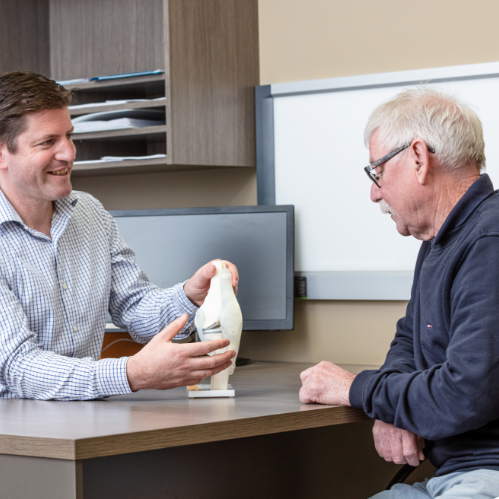
Partial knee replacement, also called unicompartmental knee replacement, replaces only the worn compartment of the knee. The remaining cartilage, the cruciate ligaments and the other compartments are retained when they are healthy. It is one option for selected patients with osteoarthritis confined to a single compartment, most often the medial (inner) side.
It is not a substitute for total knee replacement in every case. Suitability depends on symptoms, examination and imaging, not on a preference for a smaller operation alone.
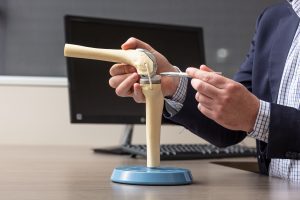
What Partial Knee Replacement Involves
The knee has three compartments: medial, lateral (outer) and patellofemoral (kneecap). In unicompartmental replacement the damaged femoral and tibial surfaces of one compartment are resurfaced with metal and polyethylene components. The anterior cruciate ligament is preserved. This differs from total knee replacement, in which both the medial and lateral tibiofemoral surfaces are replaced and the anterior cruciate ligament is removed.
A less common form of partial replacement addresses isolated patellofemoral arthritis. That procedure has a different indication and a higher revision rate in registry data. This article focuses on tibiofemoral unicompartmental replacement, which accounts for the large majority of partial knee procedures recorded in Australia.
Who May Be Considered
Assessment usually includes a history, examination and weight-bearing radiographs. Magnetic resonance imaging is used selectively when the status of the other compartments or the meniscus is uncertain.
Features that may support consideration of a partial replacement include:
- Osteoarthritis largely confined to one tibiofemoral compartment
- Intact cruciate and collateral ligaments
- A correctable deformity of modest size
- Adequate range of motion
- Inflammatory arthritis excluded
- Symptoms that persist after appropriate non-operative care
Non-operative care remains first-line for most patients. This includes activity modification, weight management where relevant, simple analgesia, physiotherapy and, in selected cases, injection treatment.
Partial replacement is less likely to be appropriate when there is inflammatory arthritis, substantial disease in more than one compartment, anterior cruciate ligament deficiency, marked fixed deformity, or inflammatory or crystalline arthropathy. In those settings total knee replacement is generally the more suitable reconstructive option.
How It Differs from Total Knee Replacement
Because the remaining compartments and the cruciate ligaments are retained, some patients describe a more familiar joint feel. The incision and bone resection are smaller than in total replacement. These differences do not mean that every patient recovers faster or that the result is superior. Recovery still requires physiotherapy, and some patients later develop arthritis in the untreated compartments.
Conversion of a partial replacement to a total knee replacement is a recognised later procedure if the implant loosens, pain persists or arthritis progresses. That operation is usually more straightforward than revision of a failed total knee replacement, but it remains further surgery.
What Australian Registry Data Show
The Australian Orthopaedic Association National Joint Replacement Registry reports that primary unicompartmental knee replacement has a higher revision rate than primary total knee replacement. Age is an important factor. Younger patients have a higher chance of later revision. Disease progression in the untreated compartments, loosening and unexplained pain are among the more common reasons for revision of a partial replacement.
A higher revision rate does not automatically mean the procedure is unsuitable. Patients selected for partial replacement tend to be younger and more active than the typical total knee replacement cohort. Surgeons and patients may also have a lower threshold to revise a partial replacement than a total replacement. Registry figures describe populations. They do not predict the course for an individual and they do not guarantee implant survival.
Implant choice, if surgery proceeds, is informed by registry performance, anatomy and the surgeon’s assessment.
Recovery in General Terms
Many patients begin walking with aids on the day of surgery or the next morning. Hospital stay is commonly shorter than for more extensive reconstructive procedures, but discharge depends on pain control, safe mobility and home support. Full weight-bearing is often permitted immediately unless otherwise advised.
Physiotherapy addresses swelling, range of motion, quadriceps activation and gait. Driving is considered only when the patient is off strong opioid medication, can sit comfortably and can perform an emergency stop. Clearance is given by the treating surgeon. Desk-based work may resume earlier than physically demanding work. Individual timelines vary.
Possible complications include infection, blood clots, stiffness, ongoing pain, fracture, loosening and the later need for revision. These risks are discussed before an operation is planned.
Assessment in Sydney, Taree and Forster
This article is for general education only. It does not provide personalised medical advice. Outcomes vary between patients. A formal consultation is required to assess whether partial knee replacement, total knee replacement or continued non-operative care is appropriate.
Dr Adam Woodbridge assesses and treats knee osteoarthritis and performs partial and total knee replacement at locations across Sydney (Chatswood, Bella Vista/Norwest and Balmain) and regional New South Wales (Taree, Forster and Bega). Further information is available at www.adamwoodbridge.com.au. Appointments can be arranged by calling 1800 447 362 or (02) 8785 5422.