
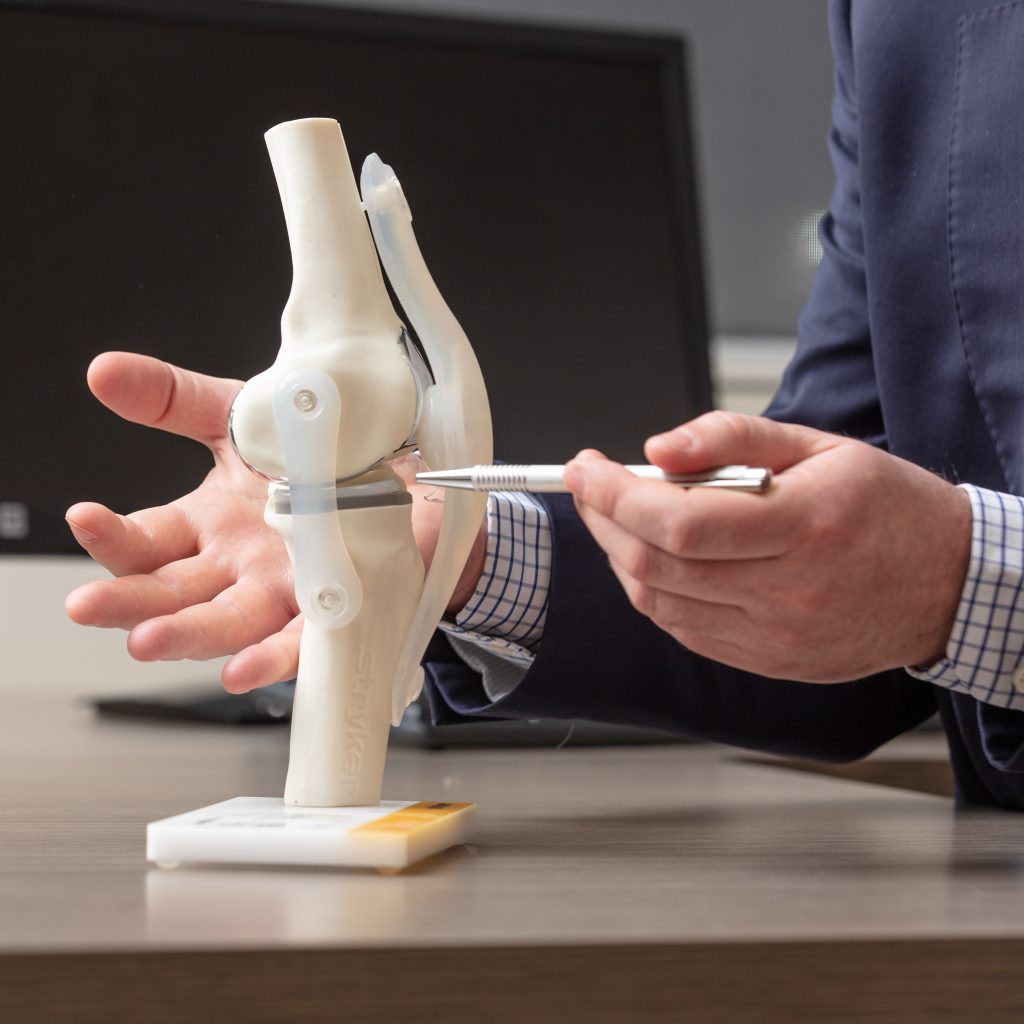
Knee Replacement Recovery Timeline: What to Expect After Total Knee Replacement
Total knee replacement offers reliable relief for advanced knee osteoarthritis when non-operative care no longer helps enough. A total knee replacement recovery phase largely determines how well patients regain function, mobility and quality of life. Age, pre-operative fitness, other medical conditions, surgical technique and how closely patients follow their rehabilitation plan all influence progress.
Most patients leave hospital within two to four days. The physiotherapy team starts mobilisation on the day of surgery or the next morning. The majority of patients recover at home with outpatient or home-based physiotherapy. Australian consensus statements from the Australian Orthopaedic Association, Australian Knee Society and Arthroplasty Society of Australia confirm that routine inpatient rehabilitation is not necessary after primary total knee replacement.
Early Recovery (Hospital to Six Weeks)
In the first weeks patients focus on controlling swelling and pain, protecting the wound, restoring full knee extension and gradually improving bending. Ice, elevation and simple compression reduce swelling. Physiotherapists guide active and assisted range-of-motion exercises, quadriceps activation and safe walking with a frame or crutches. Patients usually start full weight-bearing immediately unless the surgeon advises otherwise.
By two to three weeks many patients walk short distances indoors with less dependence on aids. By six weeks most walk independently on level surfaces and achieve at least 90–100 degrees of knee flexion. Swelling often continues for several months as part of normal healing.
Patients should avoid driving until they stop strong opioid pain medication, sit comfortably and perform an emergency stop safely. Right-knee surgery usually requires about six weeks. Left-knee surgery in an automatic vehicle may allow an earlier return. The treating surgeon confirms clearance, and patients should also check their insurance requirements.
Intermediate Phase (Six Weeks to Three Months)
Strength, endurance and confidence continue to improve. Walking distance increases and most patients stop using walking aids. Stationary cycling and hydrotherapy (once the wound heals fully) become useful. Patients often return to desk-based or sedentary work between six and eight weeks. Physically demanding jobs usually need three months or longer.
Outpatient physiotherapy or a structured home exercise programme remains valuable. Goals include further gains in range of motion (toward 110–120 degrees of flexion), progressive strengthening of the quadriceps, hamstrings and hip muscles, and normalisation of gait.
Longer-Term Recovery (Three to Twelve Months)
Functional recovery continues well beyond three months. Patients notice the greatest improvements in the first three months, yet strength, endurance and the natural feel of the knee keep improving up to one year. Low-impact activities such as walking, cycling, swimming and golf become appropriate once strength and confidence allow. Surgeons generally advise against higher-impact sports after total knee replacement.
Residual numbness around the outer aspect of the incision is common and usually settles over time. Mild aching or weather-related discomfort can persist but remains mild for most people.
The Role of Physiotherapy
Physiotherapy plays a central role throughout recovery. Early supervised sessions establish correct movement patterns and safe progression. Later stages build strength, balance and return to the activities that matter to each patient. Because recovery varies widely, physiotherapists tailor programmes rather than apply a rigid protocol.
Factors That Influence Recovery
Patients achieve better outcomes when they start with reasonable pre-operative strength and conditioning, maintain a healthy body weight and follow the prescribed rehabilitation plan. Stopping smoking and controlling medical conditions such as diabetes also support healing. Infection, stiffness that requires manipulation, or delayed wound healing can slow progress and need prompt medical review.
Assessment in Sydney, Taree and Forster
This article provides general education only. It does not give personalised medical advice. Outcomes vary between patients. A formal consultation is required to assess suitability for any approach and to plan individual rehabilitation.
Dr Adam Woodbridge assesses and treats knee osteoarthritis and performs total knee replacement at locations across Sydney (Chatswood, Bella Vista/Norwest and Balmain) and regional New South Wales (Taree, Forster). Further information is available at www.adamwoodbridge.com.au. Appointments can be arranged by calling 1800 447 362 or (02) 8785 5422.