
Knee Replacement Longevity: What the Australian Registry Shows
Knee replacement longevity refers to how long a primary total knee replacement remains in place before revision surgery is required. This article summarises population data from the Australian Orthopaedic Association National Joint Replacement Registry (AOANJRR). It is general education only. Registry figures are not a guaranteed result for any individual.
Most primary total knee replacements remain in place for many years. The AOANJRR reports cumulative revision rates for primary total knee replacement undertaken for osteoarthritis of approximately 5% at 10 years, with rates continuing to rise gradually thereafter. These are population averages across a large number of procedures. Exact figures and confidence intervals are published in the official AOANJRR Annual Reports and are updated over time. Outcomes still vary between patients.
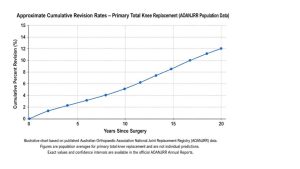
Approximate cumulative revision rates for primary total knee replacement, based on published Australian Orthopaedic Association National Joint Replacement Registry (AOANJRR) data. These are population averages and are not predictions for individual patients. Exact figures are available in the official AOANJRR Annual Reports.
What influences knee replacement longevity
Several factors are associated with the chance of later revision:
- Age at the time of surgery
- Body weight and activity level
- The type and severity of the original knee condition
- Implant design and fixation
- Surgical technique and component alignment
- Infection or other early complications
No single factor decides the result. A well-positioned implant in a patient with controlled medical conditions may last many years. Revision remains possible later in life, particularly in younger or more active patients.
Registry data versus individual results
The AOANJRR collects data on joint replacements performed in Australia. It reports cumulative revision rates for different implant types and patient groups. These are population averages. They do not predict the result for one person.
Some studies have reported that a proportion of patients are not fully satisfied after total knee replacement, even when the implant remains in place. Satisfaction and implant survivorship are related but not identical. Pain, stiffness, expectations and other medical conditions all influence how a patient feels after surgery.
Modern alignment methods, including kinematic or functional alignment within safe boundaries, and the use of navigation or robotic assistance, aim to improve ligament balance. Long-term registry data on these techniques continue to evolve. Technology alone does not guarantee a better result.
Partial knee replacement
When arthritis is limited to one compartment of the knee, a partial knee replacement may be discussed after assessment. Partial knee replacements also have registry data. Suitability is decided on examination and imaging. Further information is available in the article on partial knee replacement on www.adamwoodbridge.com.au.
Assessment in Sydney, Taree and Forster
This article is for general education only. It does not provide personalised medical advice. Outcomes vary between patients. A consultation is required to discuss implant options and expected durability for an individual.
Dr Adam Woodbridge assesses knee osteoarthritis and performs knee replacement at locations across Sydney (Chatswood, Bella Vista/Norwest and Balmain) and regional New South Wales (Taree and Forster). Further information is available at www.adamwoodbridge.com.au. Appointments can be arranged by calling (02) 8785 5422.
Reference
Australian Orthopaedic Association National Joint Replacement Registry (AOANJRR). Hip, Knee & Shoulder Arthroplasty: Annual Report. Adelaide: AOA. Available at https://aoanjrr.sahmri.com.