
By Dr Adam Woodbridge | Fellowship-Trained Orthopaedic Surgeon
Femoroacetabular impingement (FAI) occurs when abnormal contact develops between the ball (femoral head) and socket (acetabulum) of the hip joint. As a result, this repeated contact can injure the labrum and articular cartilage. In some cases it may also contribute to earlier osteoarthritis.
Dr Adam Woodbridge provides assessment for patients with hip and groin pain across Sydney and the Mid North Coast.
What is Femoroacetabular Impingement?
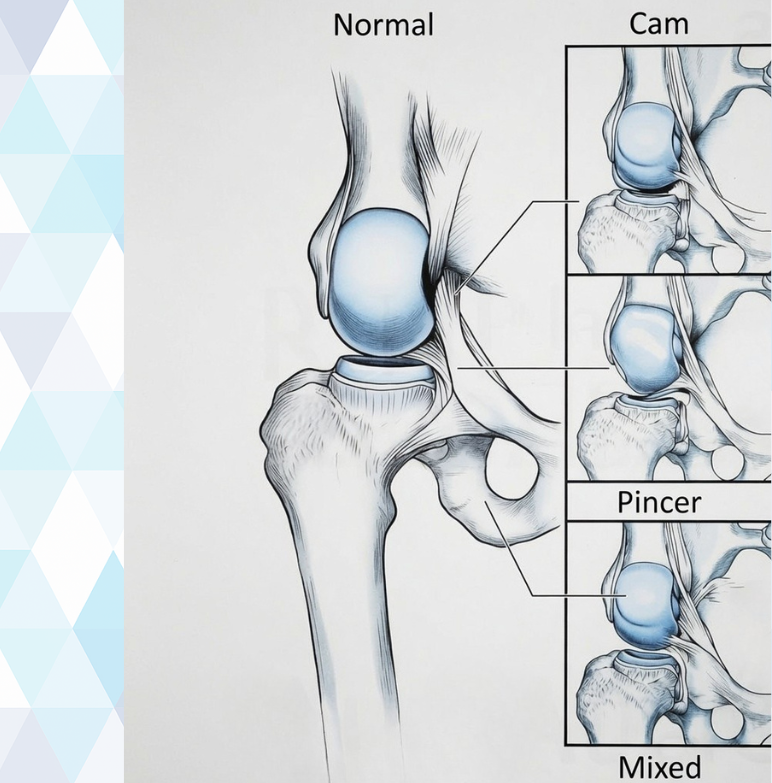
Three main patterns are recognised:
- Cam impingement – excess bone at the femoral head–neck junction
- Pincer impingement – over-coverage of the acetabulum
- Mixed impingement – features of both (most common)
These bony variations may be developmental or related to activity during skeletal growth.
Causes and Risk Factors
- Genetic factors influencing hip shape
- High-impact or repetitive hip-flexion sports in adolescence
- Prior hip trauma or developmental conditions
Not everyone with these morphological features develops symptoms.
Symptoms
Common features include:
- Deep groin pain (often described with the “C-sign”)
- Pain with prolonged sitting, rising from a chair, or twisting movements
- Reduced internal rotation of the hip
- Catching, locking or giving-way sensations
- Pain that may radiate to the buttock or thigh
Diagnosis
Diagnosis is based on history, clinical examination (including the FADIR test) and imaging. Plain radiographs assess bony morphology. MRI (often with contrast) evaluates the labrum and cartilage. Treatment decisions are guided by symptoms and imaging together, not by X-ray appearance alone.
Image placement idea 1 (after Symptoms or within Diagnosis) Anatomical diagram comparing normal hip, cam, pincer and mixed FAI. Meta: Alt text – Diagram of cam, pincer and mixed femoroacetabular impingement; Title – Types of FAI; Caption – Morphological patterns of femoroacetabular impingement.
Treatment Options
Non-surgical management (first-line for most patients):
- Activity modification
- Physiotherapy focusing on strength, control and movement patterns
- Simple analgesia or anti-inflammatories
- Image-guided injection in selected cases
Many patients achieve good symptom control with these measures.
Surgical considerations When significant symptoms persist despite appropriate non-operative care, surgical options (including hip arthroscopy in carefully selected cases) may be discussed. Where advanced cartilage damage is already present, joint-preserving procedures become less suitable. Any recommendation is individualised after thorough assessment.

When to Seek Specialist Advice
Consider assessment if groin or hip pain persists, interferes with work or sport, or is accompanied by progressive stiffness or mechanical symptoms.
Book a Consultation
Dr Adam Woodbridge assesses hip and groin conditions at locations in Sydney (including Chatswood, Bella Vista/Norwest and Balmain) and on the Mid North Coast (Taree and Forster).
Contact the rooms on (02) 8785 5422 or 1800 447 362, or book online at adamwoodbridge.com.au.
This article is for general educational purposes only and does not constitute personalised medical advice. Individual assessment is required. Outcomes vary.