
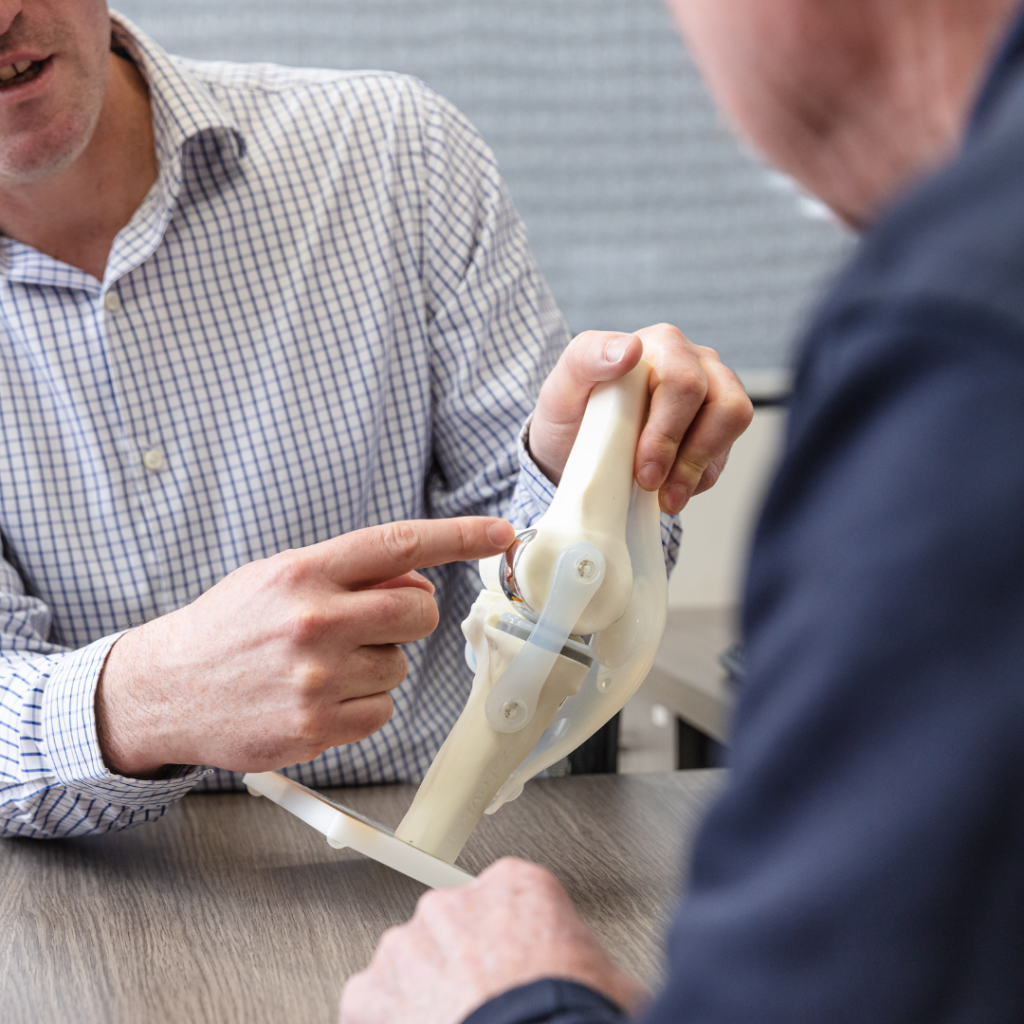
Total Knee Replacement: Alignment and Technology
Total knee replacement is an established treatment for advanced osteoarthritis of the knee when non-operative care no longer gives enough relief. Better implant designs and more durable materials have improved the longevity of modern knee replacements. Data from the Australian Orthopaedic Association National Joint Replacement Registry show that the cumulative revision rate for many current total knee replacements remains relatively low at long-term follow-up. Figures sit around 8% at 20 years for a large number of prostheses still in use.
Despite these solid survivorship results, some studies report that up to 20% of patients remain less than fully satisfied with their knee replacement. Satisfaction depends on several factors. These include residual pain, stiffness, soft-tissue balance, and how natural the replaced knee feels.
Traditional Mechanical Alignment
For many years surgeons aimed for neutral mechanical alignment. In this approach the weight-bearing axis runs from the centre of the hip, through the centre of the knee, to the centre of the ankle. The prosthetic joint line sits parallel to the floor. Osteoarthritic knees often have marked varus or valgus deformity. Achieving a neutral limb axis therefore requires significant bony correction.
Kinematic Alignment Concepts
Studies of normal knees show that true neutral mechanical alignment is uncommon. Most native knees have a slightly oblique joint line. In recent years many surgeons have moved toward restoring a patient’s own pre-arthritic alignment and joint-line obliquity. This approach is called kinematic alignment. It often involves a degree of under-correction of the original deformity. Some clinical series suggest that kinematic alignment can improve patient satisfaction and produce a more natural feeling knee in selected patients. The evidence continues to develop. Surgeons choose the alignment strategy according to each patient’s anatomy, deformity and soft-tissue status.
Enabling Technology
Computer navigation and robotic systems now help surgeons place components accurately and balance the soft tissues. These tools give real-time feedback on implant position and ligament tension. They allow fine adjustments during surgery. The technology supports the chosen surgical plan. It does not replace clinical judgement. Outcomes still depend on careful patient selection, precise technique and proper rehabilitation.
Individual assessment remains essential. The surgeon decides on alignment strategy, implant choice and the use of enabling technology after clinical examination, imaging and discussion of the patient’s goals.
This article is for general education only. It does not provide personalised medical advice. Outcomes vary between patients. A formal consultation is required to assess suitability for any particular approach.
Dr Adam Woodbridge assesses and treats knee osteoarthritis and performs total knee replacement at locations across Sydney (Chatswood, Bella Vista/Norwest and Balmain) and regional New South Wales (Taree, Forster and Bega). Further information is available at www.adamwoodbridge.com.au. Appointments can be arranged by calling 1800 447 362 or (02) 8785 5422.