
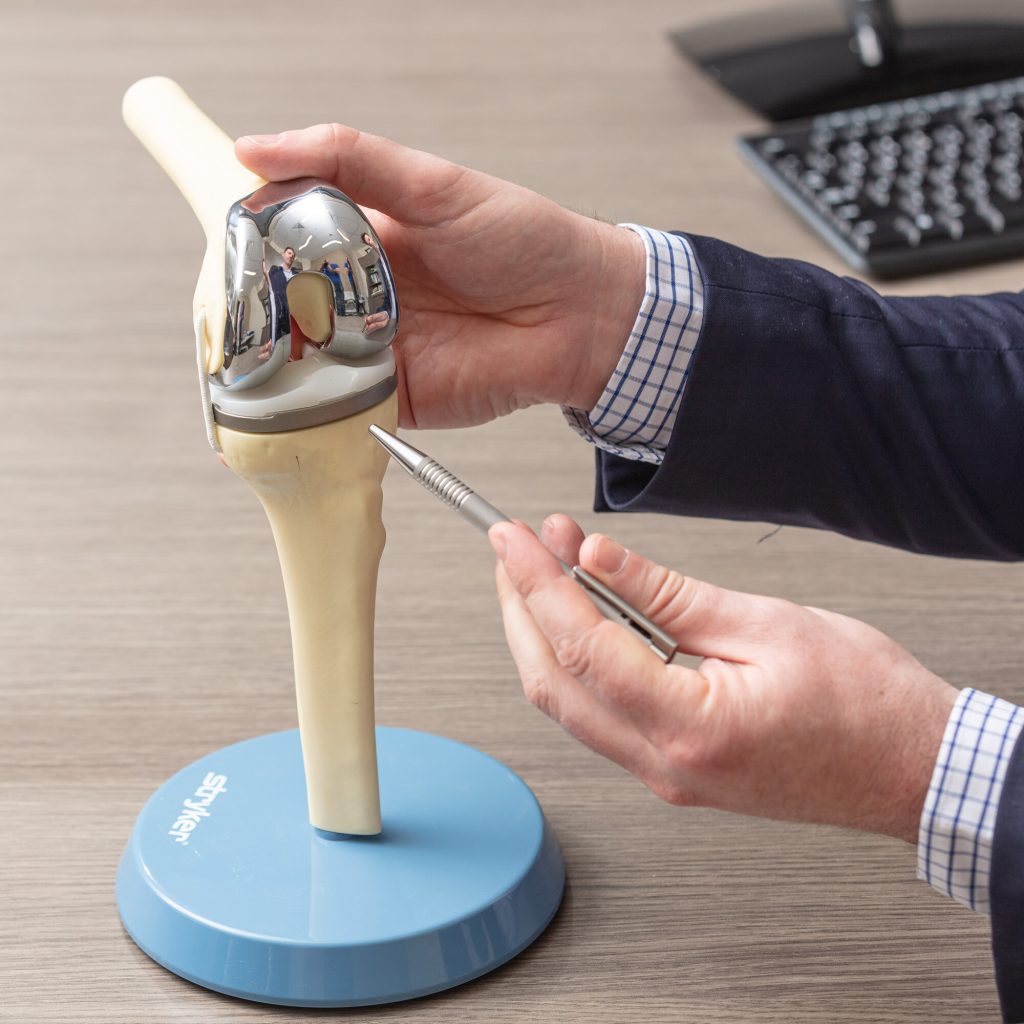
Total knee replacement is considered when knee osteoarthritis or another knee condition causes enough pain and loss of function that non-operative care is no longer enough. This article outlines common reasons a surgeon may discuss the operation. It is general education only. Suitability is decided after examination and imaging.
Not every patient with knee arthritis is offered surgery. Many people manage well for years with activity modification, physiotherapy, weight management where relevant, and medicines. Surgery is one option among others.
When non-operative care may no longer be enough
A total knee replacement may be discussed when:
- Knee pain limits walking, stairs or daily activities despite non-operative treatment
- Night pain or rest pain is persistent
- Knee deformity (bow-leg or knock-knee) is progressing and causing symptoms
- Imaging shows advanced osteoarthritis involving more than one compartment of the knee
- Other treatments, such as injections or bracing, have not given lasting relief
The decision also considers age, other medical conditions, body weight, activity goals and the patient’s preferences. A younger patient with advanced arthritis may still be offered surgery after careful discussion of the later risk of revision.
Partial versus total knee replacement
If arthritis is limited mainly to one compartment of the knee, a partial (unicompartmental) knee replacement may be considered. This replaces only the damaged compartment and leaves the remaining joint surfaces and ligaments. It is not suitable for every patient. Assessment includes examination, weight-bearing radiographs and sometimes further imaging. Further detail is available in the partial knee replacement article on www.adamwoodbridge.com.au.
What assessment involves
Assessment usually includes a history of symptoms, examination of the knee, and review of radiographs. Further scans are requested only when they will change management. Non-operative options are reviewed again before surgery is planned. Possible risks, including infection, blood clots, stiffness, ongoing pain and the later need for revision, are discussed. These events are uncommon after a primary replacement but are still explained.
Preparing for surgery if it is planned
If surgery is recommended, preparation includes medical review, medicine checks, home planning and physiotherapy where feasible. Further information is in the article on preparing for hip or knee replacement on www.adamwoodbridge.com.au.
Assessment in Sydney, Taree and Forster
This article is for general education only. It does not provide personalised medical advice. Outcomes vary between patients. A consultation is required to determine whether total knee replacement is appropriate.
Dr Adam Woodbridge assesses knee osteoarthritis and performs total and partial knee replacement at locations across Sydney (Chatswood, Bella Vista/Norwest and Balmain) and regional New South Wales (Taree and Forster). Further information is available at www.adamwoodbridge.com.au. Appointments can be arranged by calling (02) 8785 5422.