

Cooled radiofrequency ablation is a minimally invasive procedure that can provide effective pain relief for patients with knee osteoarthritis. It uses radiowaves delivered through carefully placed needles to target and ablate small nerves that transmit pain signals from the joint.
Understanding this treatment option can help guide appropriate assessment and management for chronic knee pain.
What is cooled radiofrequency ablation?
Radiofrequency ablation has been used successfully for many years in the spine. The development of ‘cooled’ radiofrequency ablation has expanded its use to peripheral joints, including the knee and hip.
In the knee, the procedure targets the genicular nerves that supply pain fibres to the joint. Cooled radiofrequency allows for a larger treatment area, which can result in more consistent and longer-lasting pain relief compared with traditional methods.
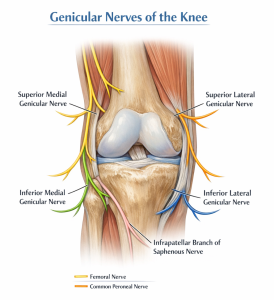
Who could benefit from cooled radiofrequency ablation?
This procedure is primarily used to treat pain from osteoarthritis of the knee. Ideal candidates include patients whose osteoarthritis is not yet advanced enough to require joint replacement surgery, but who have not responded adequately to basic non-operative treatments such as physiotherapy, medications, or injections.
It can also help delay the need for knee replacement in patients with work or travel commitments. Elderly or frail patients who may be unsuitable for major surgery can be good candidates for this less invasive option. Additionally, cooled radiofrequency ablation may provide relief for some patients experiencing chronic pain after total knee replacement.
How long does the pain relief last?
Pain relief from cooled radiofrequency ablation typically lasts around 12 months, although there is considerable individual variation. The treated nerves do eventually grow back. When pain returns, the procedure can be safely repeated. In cases where osteoarthritis has progressed significantly, joint replacement surgery may then become a more suitable option.
Is there evidence for this procedure?
Several randomised controlled trials have evaluated cooled radiofrequency ablation of the genicular nerves for knee osteoarthritis. These studies show it can provide more consistent and longer-lasting pain relief than injectable treatments such as cortisone or viscosupplementation. Complications and adverse effects are uncommon and generally mild when performed by an experienced practitioner.

Assessment in Sydney, Taree and Forster
If you are experiencing ongoing knee pain due to osteoarthritis and are looking for alternatives to major surgery, Dr Woodbridge will be happy to assess your knee in detail and discuss whether cooled radiofrequency ablation may be appropriate for you. Consultations are available in Sydney, Taree and Forster to evaluate your symptoms and review all suitable treatment options.